Biomarker and cytokine quantification
Measure a biomarker or cytokine in patient serum or plasma and confirm real binding signal.
Concentration and binding behaviour read from the same trace.
active concentration

Binding measured directly in serum, plasma, CSF, or urine, with no tag on either partner.
Measure a biomarker or cytokine in patient serum or plasma and confirm real binding signal.
Concentration and binding behaviour read from the same trace.
Measure drug-target binding directly in complex samples, from preclinical PK/PD and animal studies through to human samples.
One chip runs the full sample series, keeping early and late samples comparable.
Characterise an ADA response as kinetics, not only as titre.
Measured in the matrix the sample arrived in, with no tag on either partner.
Run a target with its controls and related markers from one small sample, in animal work, paediatric studies, or microsampling.
16 sensors on a single chip carry the panel, spotter required.
Screen capture reagents and surface chemistries against real matrix early.
Find out what holds up in matrix while the assay design can still change.
Discuss your assay with one of our application specialists.

Four independently addressable flow channels, each carrying four sensors, with the sample flowing through the channels in series.
An antifouling hydrogel layer limits adsorption of matrix proteins and lipids, and a reference channel carries what remains, so specific binding is separated from background.
bar length shows non-specific signal, not analyte response
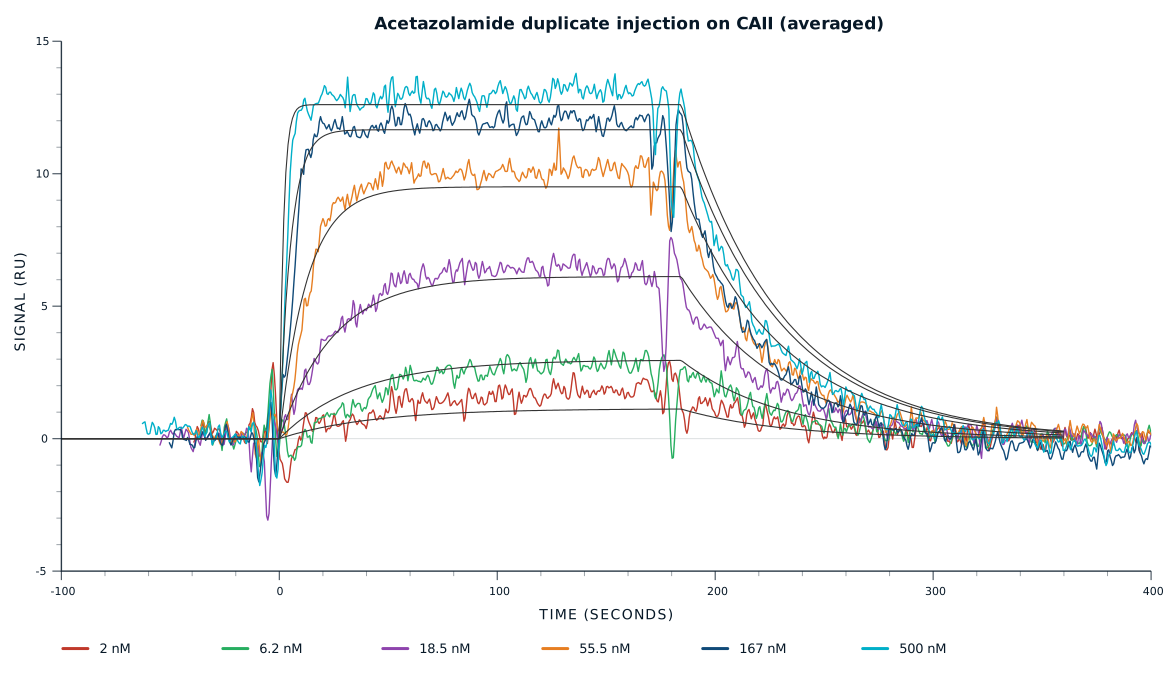
Endpoint methods report how much analyte is there at a fixed timepoint. The inQuiQ records association and dissociation as they happen, so rate, stability, and active concentration all come from the same trace.
Unpurified samples go straight in once they have passed a 0.22 µm filter, undiluted or diluted.
Every measurement follows the same steps, whatever the matrix. A capture reagent is immobilised on the sensor, the filtered sample flows past, and the instrument records the response in real time. An endpoint assay gives you one number. The inQuiQ gives you the full curve.
The capture reagent is attached to the sensor surface first.
Amine coupling or capture through a tag holds it in place on an antifouling hydrogel layer, which limits serum and plasma sticking to the surface. A reference channel without capture reagent runs alongside, so matrix background is subtracted from every injection.
Unused activated sites are capped before the first sample arrives.
Without it the surface keeps reacting with whatever passes over, and in serum or plasma that puts matrix proteins and lipids in the trace instead of the pair being measured. The response then settles at the immobilised amount.
The filtered sample flows across the surface and the response climbs.
Serum, plasma, CSF, or urine goes in undiluted or diluted, once past a 0.22 µm filter. Flow rate sets contact time, and injections up to 2 mL give a dilute analyte longer at the surface. The rising phase gives the on-rate, kon.
Buffer replaces the sample and the response falls as the complex comes apart.
The dissociation phase gives the off-rate. A concentration series yields kon, koff, and KD in the matrix the sample arrived in. For an ADA response or a drug-target pair, that is the difference between a titre and a kinetic profile, and the reading is active concentration rather than total mass.
A regeneration buffer strips what remains and returns the sensor to baseline.
The immobilised capture reagent stays in place, so every sample meets the same surface. Inject, read, regenerate, repeat, unattended. Every sensor on the chip reads each injection, so one small sample can cover a marker panel, or a target with its mismatch and off-target controls.
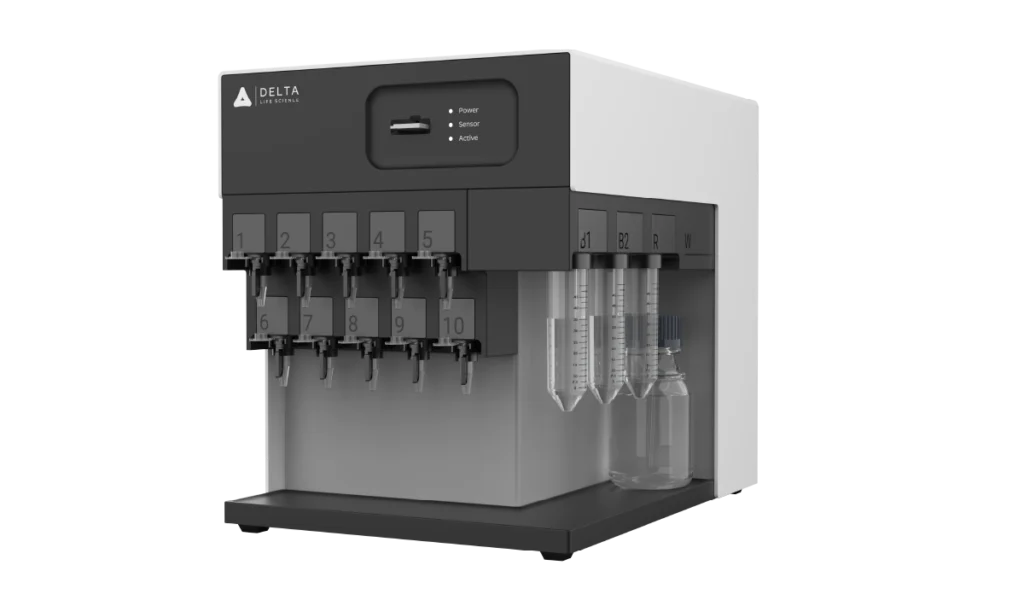
Six capabilities, one modular benchtop instrument, no label on either binding partner.
An antifouling hydrogel layer limits non-specific binding, so serum, plasma, and CSF can be measured without extensive cleanup.
Full on and off rates in matrix, so immunogenicity and drug binding are characterised as kinetic profiles rather than single endpoint values.
Binding activity is measured directly, which separates functional analyte from material that is present but not working.
30 µL is enough for a measurement, and with a spotter 16 sensors carry a biomarker panel, or a target plus its specificity controls, on one chip.
Drift stays typically below 0.3 RU per minute, so a full plate of study samples reads against the same reference.
Run toxicology, animal efficacy, and human samples on the same regenerable chip and consistent conditions, keeping results comparable across the programme.
Immobilise a capture reagent on an antifouling sensor surface, then inject filtered serum and follow binding in real time. The antifouling hydrogel limits non-specific adsorption from matrix proteins and lipids. Reference channels correct for bulk effects, so the remaining signal reflects specific binding, giving KD, kon, and koff directly in serum.
Three things do most of the work: surface chemistry that resists adsorption, referencing against a control channel to subtract bulk and background effects, and filtering the sample through a 0.22 µm filter. The antifouling hydrogel layer on the inQuiQ chips handles the first, and the 4-channel chip supports the second.
MSD is an endpoint electrochemiluminescence method: it reports how much ADA is present at one timepoint, with a tag on the detection reagent. Label-free measurement adds real-time association and dissociation with no tag, so an ADA response can be described by its kinetics and stability, not only its level.
No. Unpurified samples run directly once filtered through a 0.22 µm filter. Minimum sample volume is 30 µL, and up to 2 mL can be used when a low-concentration analyte needs longer contact time with the sensor surface.
The standard 4-channel photonic chip supports up to 4-plex with no extra hardware. With a microarray spotter, the chip carries 16 sensors, so a biomarker panel or a target plus mismatch and off-target controls can be read from a single small sample injection.