The inQuiQ768, high throughput binding affinity and kinetics
Screening campaigns stall on sample handling, not on the science. The inQuiQ768 runs the same label-free binding assay across two 96- or 384-well plate, unattended.
The inQuiQ768 is the high-throughput configuration of the inQuiQ. This modular upgrade adds an autosampler for high-throughput kinetics and endpoint screening.
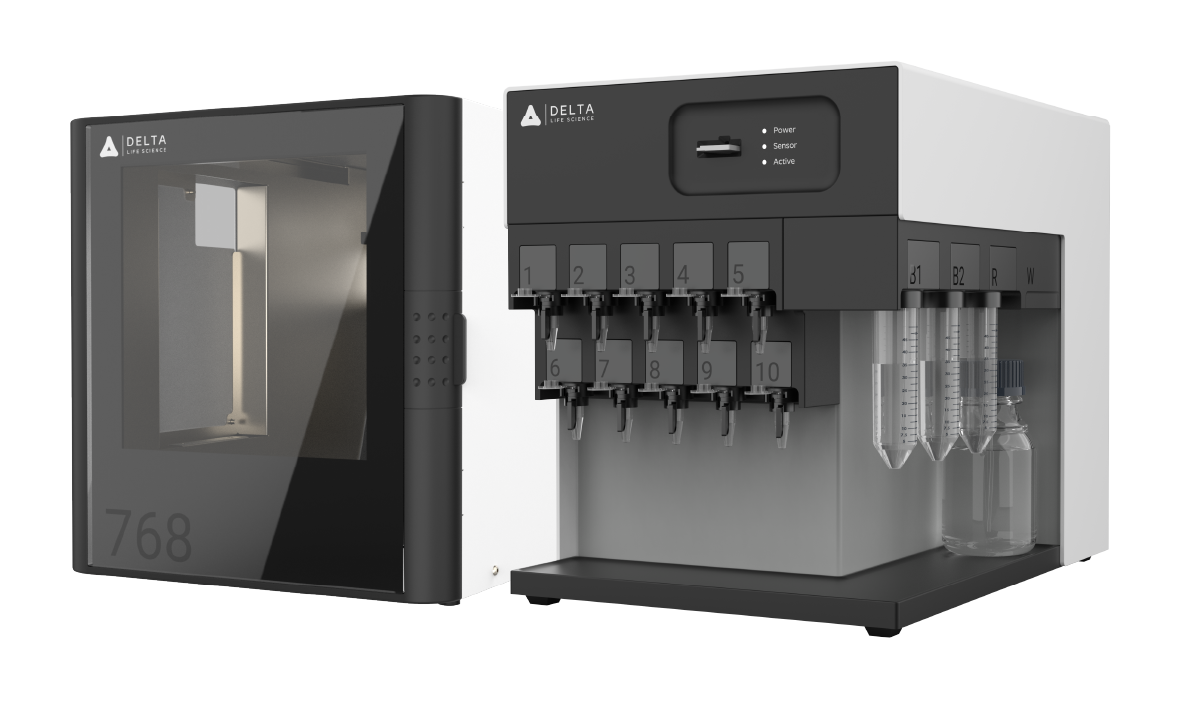
High-throughput kinetics and endpoint screening with inQuiQ768
Model: inQuiQ 768High-throughput screening
01Screen a library in one run
Up to 768 samples
02overnight kinetics analysis
Unattended sequences
03Rank clones from supernatant
Crude, 0.22 µm filtered
04See the small signals
Noise below 0.1 RU RMS
05Read samples against a panel
16 sensors, 16 targets
06Compare batch stability
One reference, same chip
01Samples + assays
Label-free binding analysis for diverse assays and screenings
Affinity and kinetics HTS
Where high-throughput screening pays off
pre-clinical cohort screening
Large clinical cohorts analysed against a biomarker panel
Antibody clone panels
Off-rate ranking from crude supernatant
Batch and biosimilarity series
Many lots against one reference standard
Diagnostic assay development
Compare biomarkers across clinical sample sets
Nucleic acid specificity panels
Aptamers, ASOs, and siRNA beside mismatch controls
Particle and membrane targets
EVs, LNPs, and lipid-layer chips across a full panel
Molecular scale
100 Da50 kDa150 kDaparticles
02Chip + flowcell
Flexibly addressable flow channels
- Four targets from one sample, up to 16 on a spotted chip
- Antifouling hydrogel surface for clean signals in complex media
- 1 to 100 µL/min flow, up to 300 µL/min for low-viscosity samples
- Regenerable surface for full measurement series on one chip
1–16 · sensor spots · pink · binding event
03Detection + performance
The chip: where the magic happens
NES photonic detection
performance
04Data + software
Kinetics data across the entire panel
Affinity
Steady-state binding and KD analysis
Kinetics
ka, kd, and KD interpretation from the sensorgram
Quantification
Concentration and biologically active concentration
Specificity
Screening, epitope binning, thermodynamics, yes/no binding
Saved sequences
One method across a campaign
Same conditions, every operator and site
Reference standards
Every plate against one standard
Batch, lot, and biosimilarity comparison
Unattended runs
The sequence finishes without you
Evenings and weekends included
05inQuiQ 768 specifications
Specifications
02Sample handling
2 × 384 well plate
2 × 96 well plate
03Output
Real-time binding response
Yes/no binding, kon, koff, and KD
Sample handling
- Channels
- 44 sensors each
- Sample capacity
- 2×96 or 2×384 well plates
- Injection volume range
- 100µl sample loop
or 250µl sample loop - Flow rate range
- 1 to 100 µL/minup to 300 µL/min for low-viscosity samples
Sensing
- Sensor chip
- HC1000M, HC30M
- Data collection rate
- 1 Hzsensitivity chips 1, 10, 100 Hzhigh-sensitivity chips
- Baseline noise
-
Typically < 0.1 RU RMSsensitivity chips
Typically < 0.01 RU RMSat 1 Hz, high-sensitivity chips*
*Coming soon - Baseline drift
- < 0.3 RU/mintypically
Measurement range
- Association rate, ka
- 101 to 107 M-1s-1
- Dissociation rate, kd
- 1 to 10-6 s-1
- Affinity, KD
- 10 pM to 10 mM
- Sample refractive index range
- Unlimited
Buffers and physical
- Running buffer capacity
- 2 × 50 mL
- Regeneration buffer capacity
- 1 × 50 mL
- Temperature control
- 16 to 40 °Cmax 4 °C below ambient
- Dimensions, W × H × D
- 63 × 36 × 57.5 cm
- Net weight
- 39 kg
06Plan a demo
See how the inQuiQ768 fits your workflow
Ready to increase your throughput?
Prefer a quote?
Download the inQuiQ brochure
request@deltalifescience.nl
Send us an email, and we will get back to you as soon as possible.
Questions researchers ask
Any workflow where one assay repeats across many samples. Fragment and compound libraries, antibody clone panels, batch and lot comparison, biosimilarity series, degrader candidate campaigns, nucleic acid specificity panels, and particle characterisation all fit. The autosampler loads up to 768 positions and injects them one after another from a saved sequence.
Yes. Load a library across two 384 well plates and run it as one saved sequence. Flow rate from 1 to 100 µL/min tunes contact time for weak, transient binders, and there is no lower molecular weight limit, so low mass fragments stay measurable.
Yes. Filter supernatant through a 0.22 µm filter and inject it directly, with no purification step. Off-rate ranking across plates of clones runs unattended, and the shortlist moves into epitope binning and full kinetics on the same surface chemistry.
Yes. Work through a candidate series of PROTACs or molecular glues under identical conditions, measuring binary and ternary binding with real time kon, and koff. Affinity is measured from 10 pM to 10 mM. Competitive assay designs isolate cooperativity and confirm E3 ligase recruiter engagement.
Yes. Nucleic acids run beside mismatch and scrambled controls on the same chip. Membrane proteins need a sensor chip that holds lipid mono or bilayers or captures nanodiscs. EVs and LNPs run at adjustable flow rate for large, slow diffusing particles.
Yes. With a spotter, each of the 16 sensors carries a different target, so drug capture, anti-drug antibody, and soluble biomarker surfaces sit in one flow path. Every injected sample is read across all of them, which replaces several single-analyte assays with one and cuts the volume drawn per timepoint."