The inQuiQ, real-time binding affinity and kinetics
The inQuiQ brings integrated photonics to label-free biosensing. By placing most of the optics on the sensor chip, we ensure signal stability while creating a highly sensitive benchtop instrument with a modular upgrade path for higher throughput.
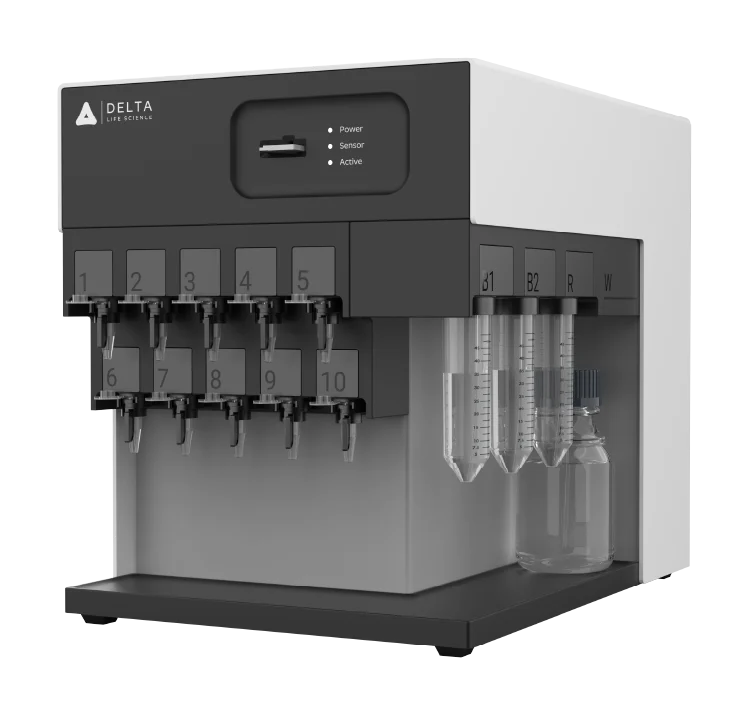
The inQuiQ at a glance
Front view
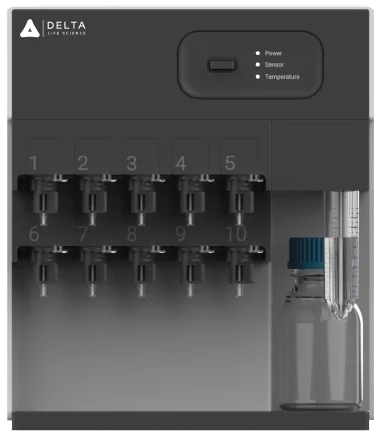
Model: inQuiQLabel-free biosensor
01Cover the full affinity range
10 pM to 10 mM
02Fits on your bench
30 × 36 × 40 cm, 18 kg
03Give slow binders more time
Injections from 5 μL to 2 mL
04See the small signals
Noise below 0.1 RU RMS
05Run serum and plasma samples
Antifouling hydrogel surface
06Modular upgrade path
inQuiQ768 autosampler
01Sample + surface chemistry
Designed around diverse samples and surface chemistries
Sample compatibility
Diverse molecule types across one platform
- Small molecules
- Nucleic acids
- Antibodies & antigens
- Proteins / enzymes
- Lipids & membranes
- Viruses & particles
Molecular scale
100 Da50 kDa150 kDaparticles
Surface chemistry
Choose the coupling strategy for your ligand
Carboxyl groups
Covalent amine coupling via EDC/NHS
Streptavidin / NeutrAvidin
Capture biotinylated ligands
Streptactin
Capture Strep-tagged proteins
Protein A/G
Immunoglobulin workflows
Lipid layers
Membrane proteins or lipid-interacting molecules
Azide groups
Click-based chemistry
02Chip + flowcell
Flexibly addressable flow channels
- Four channels with customizable flow paths
- 4-plex assays with in-flow immobilisation, up to 16-plex with a spotter
- Antifouling hydrogel surface for clean signals in complex media
- 1 to 100 µL/min flow, up to 300 µL/min for low-viscosity samples
1–16 · sensor spots · pink · binding event
03Detection + performance
The chip: where the magic happens
NES photonic detection
performance
04Data + software
Real-time data with intuitive software
Affinity
Steady-state binding and KD analysis
Kinetics
ka, kd, and KD interpretation from the sensorgram
Quantification
Concentration and biologically active concentration
Specificity
Screening, epitope binning, thermodynamics, yes/no binding
Small molecules
Small molecule interactions
No lower MW limit for organic molecules
Biomarkers
Biomarker detection in complex matrixes
Clean signal in serum, plasma, and lysate
tight binders
Stable tight-binder measurements
Low baseline drift for slow off-rates
05inQuiQ specifications
Specifications
02Minimum sample volume
from 30 µL sample
and 5 µL injection volume
03Sample handling
10 × 2 mL tubes
1.5 mL generic tubes compatible
04Channels
4 channels, each containing 4 sensors
05Temperature control
16 °C to 40 °C
06Output
Real-time binding response
Sample handling
- Channels
- 44 sensors each
- Sample capacity
- 10 × generic 1.5 or 2 mL tubes
- Minimum sample volume
- 30 µL50 µL recommended
- Injection volume range
- 30 µL to 2 mL
- Flow rate range
- 1 to 100 µL/minup to 300 µL/min for low-viscosity samples
Sensing
- Sensor chip
- HC1000M, HC30M
- Data collection rate
- 1 Hzsensitivity chips 1, 10, 100 Hzhigh-sensitivity chips
- Baseline noise
-
Typically < 0.1 RU RMSsensitivity chips
Typically < 0.01 RU RMSat 1 Hz, high-sensitivity chips*
*Coming soon - Baseline drift
- < 0.3 RU/mintypically
Measurement range
- Association rate, ka
- 101 to 107 M-1s-1
- Dissociation rate, kd
- 1 to 10-6 s-1
- Affinity, KD
- 10 pM to 10 mM
- Sample refractive index range
- Unlimited
Buffers and physical
- Running buffer capacity
- 2 × 50 mL
- Regeneration buffer capacity
- 1 × 50 mL
- Temperature control
- 16 to 40 °Cmax 4 °C below ambient
- Dimensions, W × H × D
- 30 × 36 × 40 cm
- Net weight
- 18 kg
06Plan a demo
See how the inQuiQ fits your workflow
Ready to see the inQuiQ in action?
Prefer a quote?
Download the inQuiQ brochure
request@deltalifescience.nl
Send us an email, and we will get back to you as soon as possible.
Questions researchers ask