
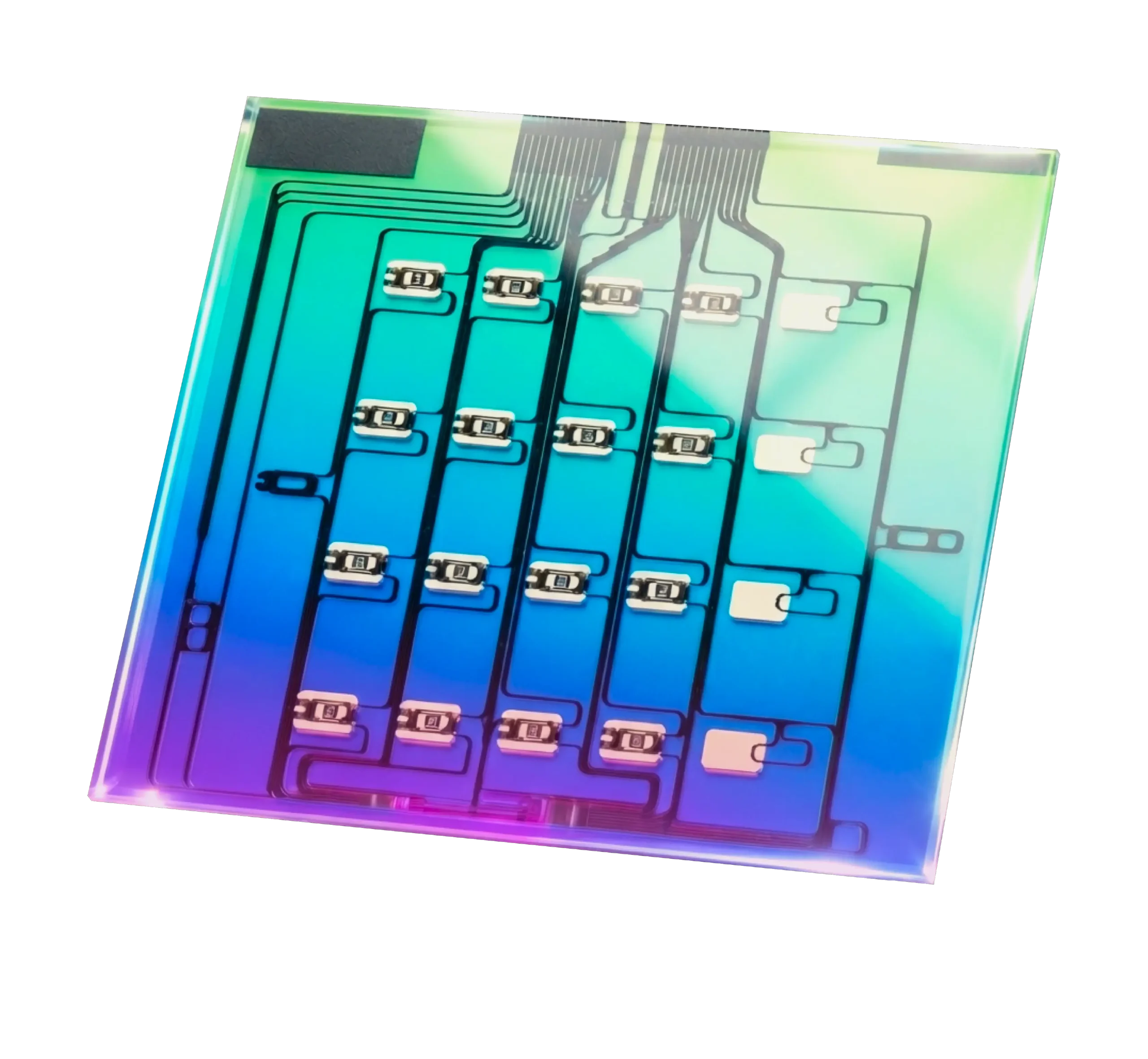
Sensor chips for label-free binding analysis
01Surface chemistry
Two hydrogel surfaces, matched to the binding questions
HC1000M
Low molecular weight analytes with small binding signals.
Concentration and quantification with standard curves.
Panel screening across multiple candidates.
Specificity testing with mismatch or off-target controls.
HC30M
Affinity determination with clean equilibrium responses.
Full kinetic characterisation.
Concentration series on a single immobilised target.
Sensorgram fit quality driving the interaction result.
02Sample types
Designed around diverse samples and surface chemistries
Sample compatibility
Diverse molecule types across one platform
- Small molecules
- Nucleic acids
- Antibodies & antigens
- Proteins / enzymes
- Lipids & membranes
- Viruses & particles
Molecular scale
100 Da50 kDa150 kDaparticles
Surface chemistry
Choose the coupling strategy for your ligand
Carboxyl groups
Covalent amine coupling via EDC/NHS
Streptavidin / NeutrAvidin
Capture biotinylated ligands
Streptactin
Capture Strep-tagged proteins
Protein A/G
Immunoglobulin workflows
Lipid layers
Membrane proteins or lipid-interacting molecules
Azide groups
Click-based chemistry
03Chip + flowcell
Flexibly addressable flow channels
- Four channels with customizable flow paths
- 4-plex assays with in-flow immobilisation, up to 16-plex with a spotter
- Antifouling hydrogel surface for clean signals in complex media
- 1 to 100 µL/min flow, up to 300 µL/min for low-viscosity samples
1–16 · sensor spots · pink · binding event
04inQuiQ specifications
Specifications
01Sensors for complex samples
Antifouling layer keeps background signal low in complex samples.
02Regeneration and reuse
Regenerate the surface to test different samples with the same ligand.
03Consumable economics
Up to 16 different immobilised ligands on a spotted chip.
Sensor chip
Measurement range
Performance
*Coming soon
Sample and physical
05Get a quote
Get a quote for inQuiQ sensor chips
Tell us what you need
Talk to an application scientist
Download the inQuiQ brochure
request@deltalifescience.nl
Send us an email, and we will get back to you as soon as possible.
Questions researchers ask
Both chips carry a polycarboxylate hydrogel over the photonic sensor. The HC1000M uses long chains and suits low molecular weight analytes, quantification, screening, and specificity panels. The HC30M uses short chains and suits affinity determination and full kinetic characterisation. Many programmes screen on one and confirm on the other.
Each chip has four channels with four sensors, 16 in total. Immobilised in flow, 4 different ligands can be immobilised on the chip . With a microarray spotter the sensors are addressed individually, giving up to 16 ligands for one measurement, including controls and reference surfaces.
Yes. The hydrogel surface is regenerable. After each injection the bound analyte is stripped and the surface returns to baseline, so one chip carries a full concentration series and keeps the same immobilised target in place across a measurement series.
Some immobilisation techniques, such as Protein A/G, also allow the ligand to be stripped, enabling different ligands to be immobilised and measured sequentially on the same sensor.
Yes. The antifouling hydrogel is built for serum, plasma, cell culture supernatant, and other complex matrices, where background binding usually limits the measurement. Filter the sample through a 0.22 µm filter and inject it directly. No purification step is needed first.
The chips support affinities (KD) from 10 pM to 10 mM, association rates (kon) from 101 to 107 M-1s-1, and dissociation rates (koff) from 1 to 10-6 s-1. Baseline noise is typically below 0.1 RU RMS, which supports work with weakly binding analytes.