Upstream titer
Track antibody titer through the bioreactor run.
Measure straight from clarified cell culture supernatant.
cell culture supernatant

Label-free interaction analysis measures real-time binding of unmodified molecules, enabling active concentration, binding kinetics, and batch-to-batch comparability without labels or secondary antibodies.
Track antibody titer through the bioreactor run.
Measure straight from clarified cell culture supernatant.
Rank clones on what they actually produce.
Compare titer and binding activity across candidate lines.
Follow the product through capture and polishing.
Check binding activity after Protein A, ion exchange, and SEC.
Confirm the product still engages its target.
Active concentration reports function, not total protein mass.
Run candidate and reference standard on the same chip.
Compare kon, koff, and KD side by side across lots.
Discuss your assay with one of our application specialists.

Four independently addressable flow channels, each carrying four sensors, with the sample flowing through the channels in series.
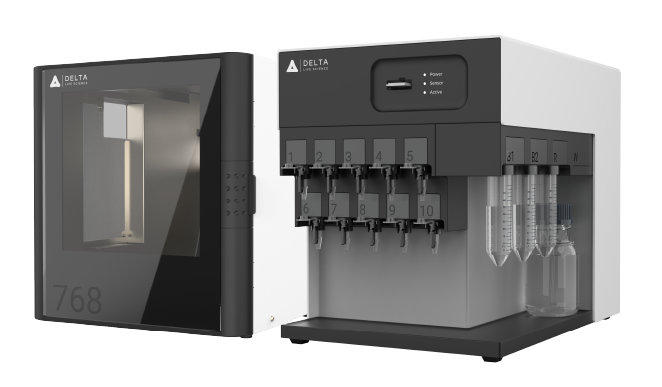
The inQuiQ768 autosampler takes 2×96 or 2×384 well plates and injects one sample after another. Samples run in series, so every batch meets the same surface under the same conditions.
A standard curve of the reference material turns binding response into active concentration. Total protein mass counts everything in the sample; active concentration counts only what engages the target.
Immobilise the reference material alongside candidate lots and inject once. Up to sixteen targets and controls are read from a single spotted chip, so comparability comes from one run.
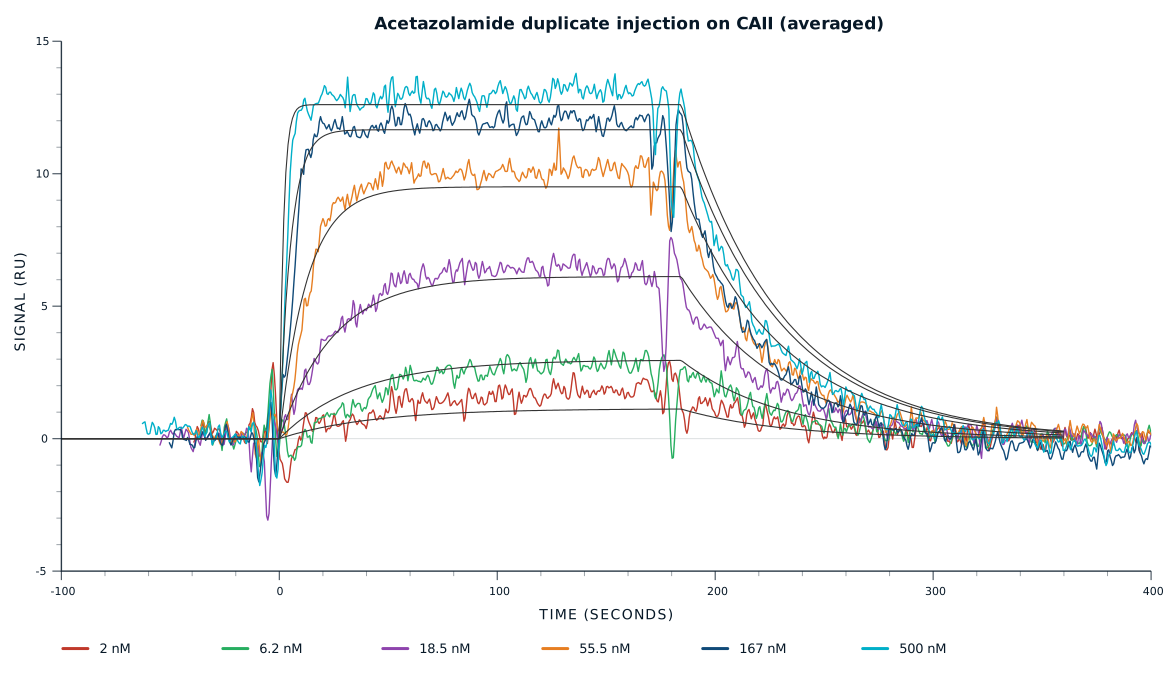
Every measurement follows the same steps, whatever the stage. A capture ligand is held on the sensor, the sample flows past, and the response is recorded through the whole injection rather than at the end.
The capture ligand goes on the sensor surface first.
For antibody titer and active concentration assays, Protein A, the antigen, or a receptor is coupled once and the same surface then serves every batch. Ligand density is set low enough that titer readings are not limited by transport to the surface.
Unused activated sites are switched off before the first supernatant arrives.
Cell culture supernatant carries host cell protein and media components. Deactivation, together with the antifouling hydrogel, keeps those out of the sensorgram as non-specific binding.
The sample flows across the surface and the response climbs.
In bioprocessing kinetics analysis the association phase gives kon and, read against a standard curve, the active concentration of product in the sample. Supernatant is clarified through a 0.22 µm filter before injection.
Buffer replaces the sample and the response falls as the complex comes apart.
The dissociation phase gives koff, and kon with koff gives KD. Comparing those three numbers lot to lot is how potency, identity, and biosimilarity are tracked from upstream through release testing.
A regeneration buffer returns the sensor to baseline for the next batch.
The capture ligand stays in place, so every lot and the reference standard meet the same surface. On the inQuiQ768 a full plate of batches runs unattended.
Six capabilities, one modular benchtop instrument, in a label-free workflow.
Four channels with in-flow immobilisation, or sixteen sensors with a spotter, put batches and controls on the same capture surface.
A standard curve of the reference material turns binding response into the concentration of product that still engages its target.
The antifouling hydrogel keeps host cell protein and media components out of the trace, with samples filtered through 0.22 µm.
Candidate lots and the reference material sit on one chip and meet the same injected sample, so comparability is read from one run.
kon, koff, and KD are measured the same way upstream, downstream, and at release, so the numbers compare across the process.
The autosampler takes 2×96 or 2×384 well plates and works through them one injection after another.
Immobilise Protein A or the antigen on the sensor, inject clarified supernatant, and read the binding response against a standard curve of the reference material. No secondary antibody and no label is needed, and the result is the concentration of antibody that still binds rather than total protein mass.
Run a dilution series of a reference standard to build the curve, then inject the unknown sample under the same conditions and read its response across. Because only material that engages the immobilised ligand contributes signal, the number reports functional product, which is what potency assays need.
Usually yes, after clarification through a 0.22 µm filter. The antifouling hydrogel surface limits binding by host cell protein and media components, and a reference channel subtracts what remains. That removes a purification step between the bioreactor and the number.
Put both on the same chip and inject the same sample series. Measuring kon, koff, and KD side by side under identical conditions makes the comparison a single experiment rather than two runs that have to be normalised against each other afterwards.
The inQuiQ768 autosampler holds 2×96 or 2×384 well plates and works through them one injection after another. Samples run in series, never in parallel, so every batch meets the same prepared surface under the same conditions across the sequence.