Even subtle binding is visible
Fragments, low affinity hits and low abundance targets produce signal instead of noise. Baseline noise sits typically below 0.1 RU RMS.
sensitivity

NES technology explained
Label-free means nothing is stained, tagged, or amplified. The molecule's own mass is the signal, and binding is recorded while it happens.
At the right wavelength, the light resonates inside the ring, circulating many times and passing the same sensing area over and over.
That tail defines the sensing area. Only molecules within the evanescent field influence the optical signal.
Refractive index describes how light interacts with a material. Even small changes affects the optical signal.
Larger shifts indicate more bound material on the sensor surface.
Fitting both phases returns kon, koff and KD from a single run.
n₁ > n₂ - light circulates in the ring
Fragments, low affinity hits and low abundance targets produce signal instead of noise. Baseline noise sits typically below 0.1 RU RMS.
Read multiple targets from a single injection. Our photonic chip has 4 channels for in-flow immobilisation, and 16 sensors that can be immobilised with a spotter.
The instrument is 30 by 40 cm and ready five minutes after switch-on. Conventional systems need between 1 and 24 hours to stabilize.
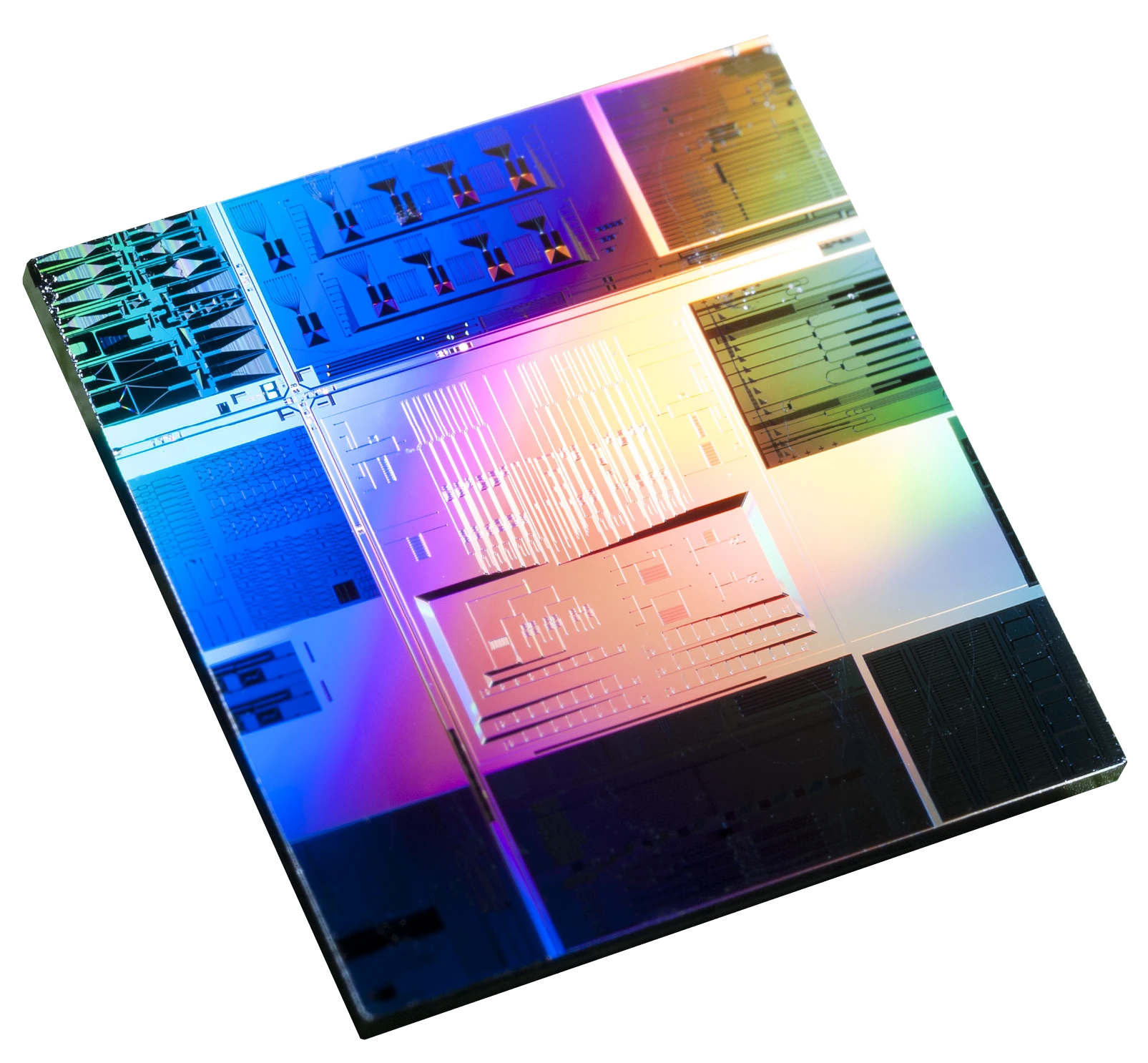
The inQuiQ replaces complex optical assemblies with a compact photonic chip. This enables sensitive measurements below 0.03 RU RMS at lower cost.
Four label-free methods answer binding questions in different ways. How each one generates its signal shows up directly in sensitivity, throughput and cost.
The bands are qualitative and describe typical instruments in each category, not one product. Platforms within a category vary.
No method leads everywhere. BLI runs more samples per shift and handles crude material without microfluidics. ITC measures binding heat directly in solution, which no surface method does.
A mass sensor registers what attaches and how fast. Conformational change adds no mass, so cryo-EM, X-ray and NMR stay the route to structure.
Every assay starts with immobilisation or capture. For interactions that only happen free in solution, ITC and MST measure without a surface.
A sensor reports that something bound, not what it was. Mass spectrometry identifies the species behind a signal.
A temperature series gives thermodynamic parameters through van 't Hoff analysis. ITC measures heat directly and remains the route to enthalpy.

Label-free platforms fall into three groups. SPR systems (Cytiva Biacore, Bruker Sierra SPR, Carterra LSA) read a gold film through a prism. BLI systems (Sartorius Octet, Gator Bio) read a dip sensor moved between wells. Our photonic chip systems read light in a waveguide, which is how the inQuiQ from Delta Life Science fits 16 high sensitivity sensors on one chip in a benchtop instrument.
All three detect binding without labels. SPR reads a gold film lit through a prism and needs optical alignment and roughly an hour to stabilise. BLI reads a dip sensor moved between wells, which makes it good for complex matrices, but less sensitive with fragments and small molecules. NES uses highly sensitive waveguide sensors etched into a silicon chip, so the inQuiQ has no optics to stabilise every time and is ready five minutes after switch-on.
The inQuiQ covers the same core measurements: KD, kon, koff, specificity, epitope binning and active concentration, across affinities from 10 pM to 10 mM. What changes is access. NES enables an affordable instrument with a sensitivity of up to 0.03 RU RMS, running serum and lysate directly after a 0.22 µm filter, sensors regenerate for reuse, and the instrument sits on your own bench.
ELISA returns an endpoint, meaning how much analyte is present after washing and detection. Label-free methods like Nanophotonic Evanescent field Sensing record binding as it happens, so one run gives association rate, dissociation rate and affinity. No label sits on either partner, and the inQuiQ reads unpurified samples without a coating, blocking or detection step.
Every run with the inQuiQ returns a sensorgram: association while sample flows over the surface, dissociation while buffer flows. Fitting both phases gives kon, koff and KD. The inQuiQ covers 10 pM to 10 mM, association rates from 10¹ to 10⁷ M⁻¹s⁻¹, dissociation rates from 1 to 10⁻⁶ s⁻¹, with baseline noise below 0.1 RU RMS for sensitivity sensors, down to 0.03 RU RMS for high sensitivity sensors.