Domain-level interactions
Find out which part of a multi-domain protein carries the binding.
Competitive and blocking assays compare truncations and mutants against the full-length protein.
competitive assays

Label-free interaction analysis measures binding between unmodified molecules in real time. For structural biology it returns affinity, association and dissociation rates, and specificity in solution, so an atomic-resolution model can be tested against how the complex actually forms, how long it holds, and how it comes apart.
Find out which part of a multi-domain protein carries the binding.
Competitive and blocking assays compare truncations and mutants against the full-length protein.
Test an AlphaFold or docking prediction at the bench.
A measured KD either supports the predicted interface or it does not.
Confirm a construct still binds the way its parent does.
Stabilised, truncated, and mutated constructs measured side by side before they enter a structural pipeline.
Check that the complex forms before it takes up beam or microscope time.
Confirm binding and estimate how long the complex holds together, so structural work goes to samples that behave.
Run the same interaction across a temperature series.
The temperature-controlled flow cell adds the thermodynamic layer to a binding measurement.
Discuss your assay with one of our application specialists.

Truncations, point mutants, and controls sit on the same chip, so a construct series moves as a batch rather than one measurement per surface.
*spotter necessary for 16-sensor immobilisation
The rising phase gives kon, the falling phase gives koff, and together they give KD. Affinity runs from 10 pM to 10 mM, with steady-state fitting where dissociation is too fast for kinetics.
The analyte stay unmodified in solution, so the interaction is recorded as it behaves rather than as a tag or a label allows it to behave.
Run the full-length protein against its truncations and point mutants, then use competitive and blocking assays to find the construct that keeps the affinity. The comparison localises an interaction without a new structure for every variant.
Every measurement follows the same steps, whatever the complex. One partner is immobilised on the sensor, the other flows past, and the instrument records the response in real time. An endpoint assay gives you one number. The inQuiQ gives you the full curve.
One binding partner is attached to the sensor surface first.
Amine coupling or capture through a tag holds the protein in place. For a protein pair, the more stable or more readily produced partner usually is immobilised on the surface, and the other is injected. Ligand density is set high enough for a clear response without crowding the surface.
Any activated site left unused is capped before the first sample arrives.
Without it the surface keeps reacting with whatever passes over, and non-specific binding shows up in the trace as signal that has nothing to do with the pair being measured. The response settles at a stable level, the immobilised amount.
The second partner flows across the surface and the response climbs.
Sample and running buffer are matched, since a small solvent mismatch shifts the bulk signal more than the binding does, and a reference channel subtracts what remains. Flow between 1 and 100 µL/min sets contact time, up to 300 µL/min for low-viscosity samples. The rising phase gives the on-rate, kon.
Buffer replaces the sample and the response falls as the complex comes apart.
The falling phase gives the off-rate, koff, and 1/koff gives how long the complex holds together. Fit a concentration series and you get kon, koff, and KD across 10 pM to 10 mM. Where dissociation is too fast to fit, the plateau of each injection gives steady-state affinity. Single-cycle kinetics runs the series uninterrupted when protein is scarce.
A regeneration buffer strips the bound partner and returns the sensor to baseline, ready for the next injection.
The immobilised partner stays in place, so every variant in a series meets the same surface. Inject, read, regenerate, repeat, unattended. Samples run one after another, and each injection is read by every sensor on the chip, so one sample can cover several constructs, mutants, or controls at once.
Six capabilities, one modular benchtop instrument, no labels anywhere in the workflow.
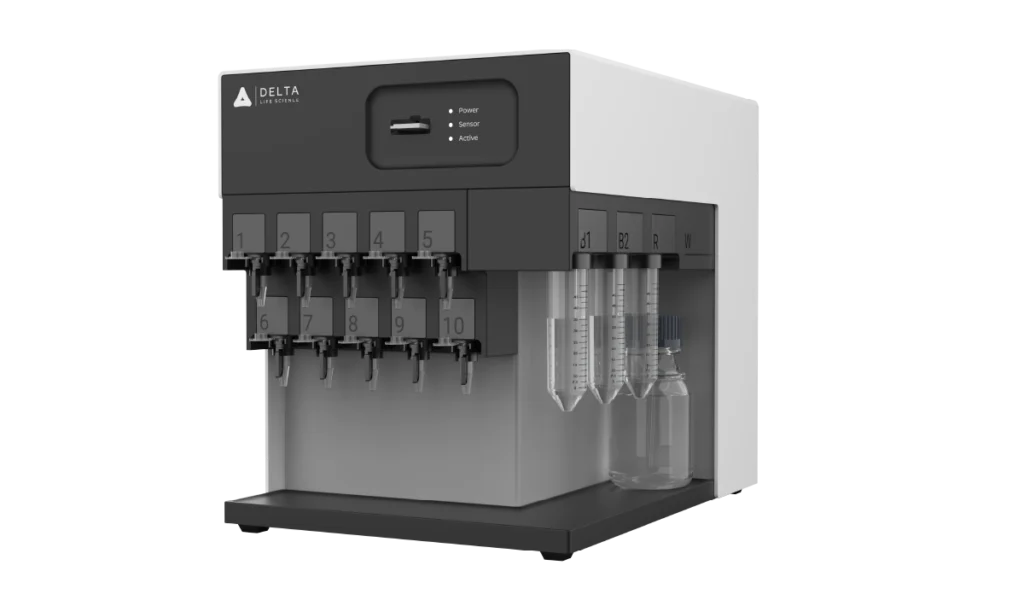
Four flexibly addressable channels for improved assay freedom, with 16 sensors to read truncations, point mutants, and controls against one injected sample.
Baseline noise stays low enough that a small binding response is still readable.
One affinity range spans the weak contacts at the edge of a model and the tight complexes at its centre, with steady-state fitting where kinetics run out.
Competitive and blocking assays show which construct or domain carries the binding, on the same surface as the full-length protein.
The temperature-controlled flow cell runs a full temperature series.
Simply add an autosampler, and run a long variant or condition series unattended.
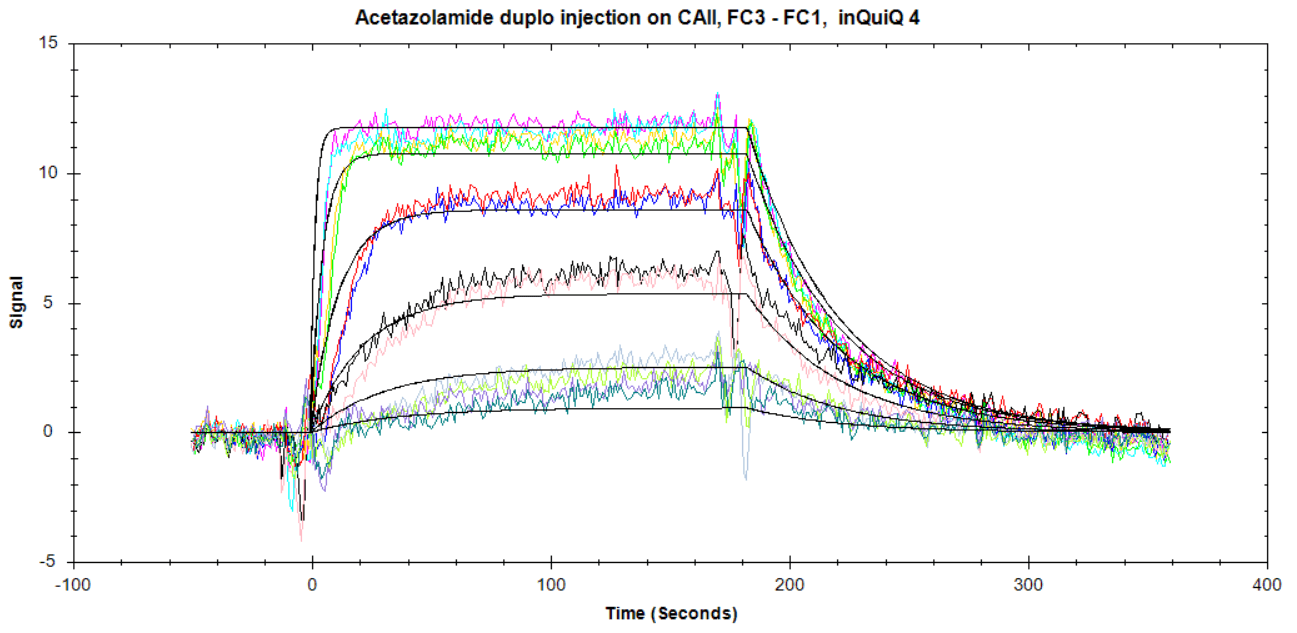
This white paper showcases the high sensitivity of ring resonator technology for measuring low-molecular-weight interactions, using Carbonic Anhydrase II (CAII) and two small-molecule binders as a model system.
Cryo-EM, X-ray crystallography, and NMR give structure. Label-free interaction analysis, ITC, mass photometry, and SEC-MALS give function and behaviour in solution. Label-free analysis with the inQuiQ adds affinity (KD) and kinetics (kon, koff), so you can show that a modelled interface produces measurable, specific binding under native conditions.
Express the predicted partners, measure their binding in solution, and compare the result with the prediction. A measured KD and a clean sensorgram support the model. Competitive assays against truncations or point mutants then test whether the predicted interface is the one that actually drives binding.
The inQuiQ runs from 30 µL of sample. Sensors are regenerable, so the same chip carries a series of variants, mutants, and controls rather than one measurement per surface. That matters for structural constructs that are slow to express or purify.
Yes, indirectly and reliably. Run the full-length protein on the inQuiQ and its truncations or domain constructs as separate binding experiments, then use competitive and blocking assays to see which construct carries the affinity. The comparison localises the interaction without needing a new structure for every variant.
Affinity (KD) says how tightly two molecules bind at equilibrium. Kinetics says how they get there: kon for how fast the complex forms, koff for how fast it falls apart. Two complexes can share a KD and behave differently, which is why structural work benefits from both.