Monoclonal antibodies
Rank clones by off-rate to find the slowest dissociating binders.
Full kinetics and affinity for every lead candidate.
kon, koff, KD

Each format has its own testing needs. inQuiQ covers them from one platform.
Rank clones by off-rate to find the slowest dissociating binders.
Full kinetics and affinity for every lead candidate.
Confirm that both arms reach their targets.
Sequential and simultaneous assays check each arm separately.
Clean kinetics from low molecular weight formats.
VHH, scFv, and Fab produce only a small mass change on binding.
Check that conjugation has not altered target binding.
Compare the ADC against its parent antibody under the same conditions.
See how Fc changes affect binding to antigen and partner proteins.
A temperature series adds thermodynamic detail.
Discuss your application with one of our application specialsts.

Targets and cross-reactivity controls measured together, so the panel moves as a batch instead of a queue.
*spotter necessary for 16-sensor immobilisation
A small mass change still resolves into a full curve, so VHH, scFv, and Fab return real kinetics.
The binder and its target meet unmodified, and the sensor reads the interaction itself rather than a reporter standing in for it.
The sample flows over the sensor after one filter step, and the antifouling hydrogel reduces non-specific binding. Trusted data, fewer purification steps.
Every measurement follows the same five steps, whatever the format. The antigen or the antibody goes on the sensor, the binding partner flows past, and the instrument records the response in real time. An ELISA gives you one number at the end. inQuiQ gives you the full curve.
The partner that stays put is attached to the sensor surface first.
Antigen coupled directly, or antibody held by a capture reagent. That choice matters for IgG: a captured bivalent antibody meeting surface-bound antigen binds with both arms, so the result reflects avidity rather than monovalent affinity. Immobilise the antigen instead and you read one arm at a time.
Any activated site left unused is capped before the sample arrives.
Without it the surface keeps reacting with whatever passes over, and non-specific binding shows up in the trace as signal that has nothing to do with the pair being measured. The response settles at a stable level, the immobilised amount.
The sample flows across the surface and the response climbs.
Purified protein or crude hybridoma supernatant after a 0.22 µm filter, both go in the same way. Flow between 1 and 100 µL/min sets contact time, which matters for a nanobody or scFv producing only a small mass change. The rising phase gives the on-rate, kon.
Buffer replaces the sample and the response falls as the complex comes apart.
The falling phase gives the off-rate, koff, and it can be read on its own, which is why clones can be ranked before any of them is purified. Fit a concentration series and you get kon, koff, and KD: separate cycles for multi-cycle kinetics, one uninterrupted series for single-cycle when material is scarce.
A regeneration buffer strips the remaining analyte and returns the sensor to baseline, ready for the next run.
The immobilised partner stays in place, so every clone in an affinity maturation series meets the same surface under the same conditions. Inject, read, regenerate, repeat, unattended. And every injection is read by all sixteen sensors at once, so one sample can cover sixteen targets, variants, or cross-reactivity controls.
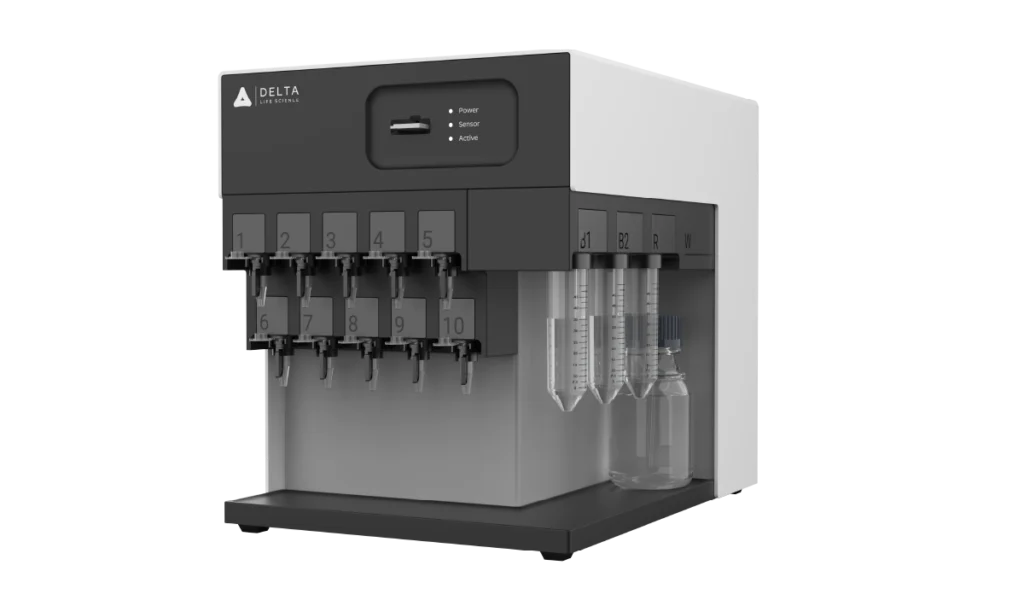
Six capabilities, one benchtop instrument, no labels anywhere in the workflow.
4 channels to read a single injection, so targets and controls are measured together.
Competitive and cross-blocking assays sort a panel into bins.
Single-cycle and multi-cycle runs give the whole curve, not an endpoint.
Sequential and simultaneous assays check that both arms of a bispecific reach their targets.
The temperature-controlled flow cell runs a full temperature series.
Simply add an autosampler, and increasy your throughput for library screens.
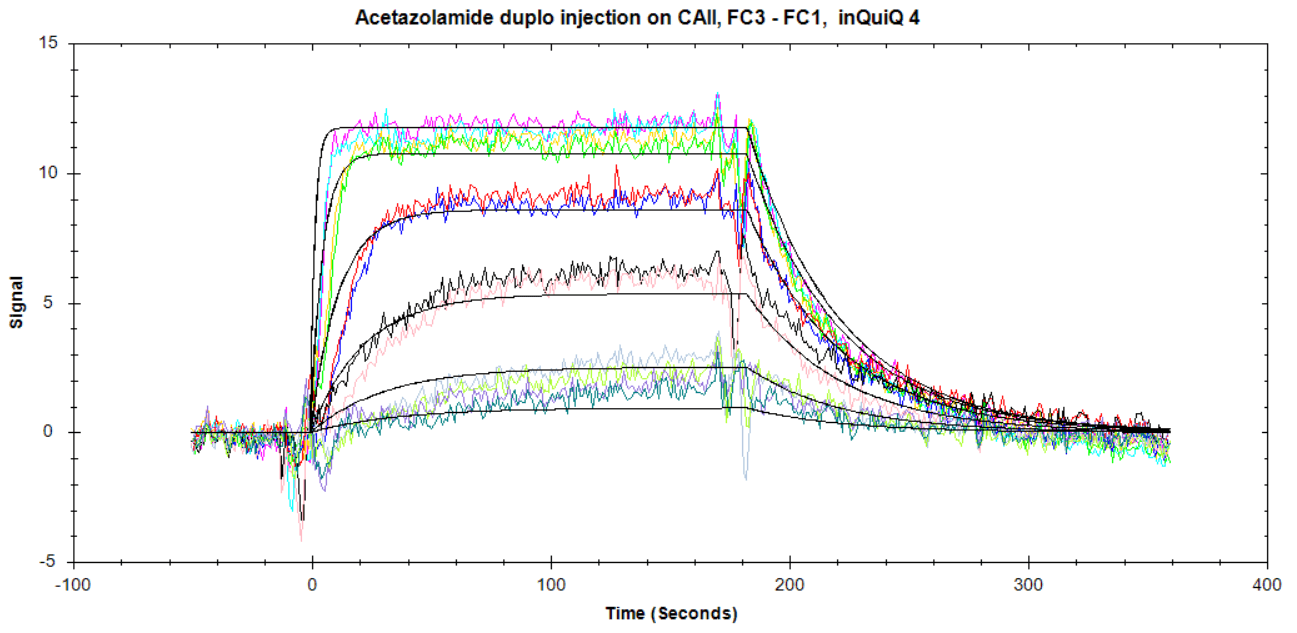
This white paper showcases the high sensitivity of ring resonator technology for measuring low-molecular-weight interactions, using Carbonic Anhydrase II (CAII) and two small-molecule binders as a model system.
Immobilize the antigen or capture the antibody on the sensor, then inject a concentration series of the binding partner. inQuiQ records association and dissociation in real time and fits the data to give affinity (KD) and kinetics (kon, koff), across a range of 10 pM to 10 mM, without any label.
Off-rate ranking sorts candidates by how slowly they release their target, since a slow off-rate (koff) often signals a stronger, longer-lived interaction. inQuiQ captures each antibody, records dissociation in real time, and ranks the panel by koff, so you can shortlist the slowest dissociating binders early, even from crude supernatant.
Epitope binning groups a panel of antibodies by the region of the antigen they bind. Antibodies that block each other likely share an epitope, while pairs that bind together fall into different bins. inQuiQ runs competitive and cross-blocking assays that reveal these bins and show which candidates compete for the same site.
A bispecific must engage both of its targets to work. inQuiQ confirms this with sequential and simultaneous binding assays: capture the bispecific, inject the first antigen, then the second, and watch whether both bind. You get affinity and kinetics for each arm and confirmation that the molecule bridges both targets.
A nanobody (VHH) is small, so binding produces only a small mass change that some label-free platforms miss. inQuiQ measures binding across an affinity range of 10 pM to 10 mM and returns full kinetics (kon, koff) and affinity (KD) for VHH, scFv, and Fab formats from as little as 30 µL of sample.