
Label-free kinetics built for study volumes

Throughput, multiplexing, and assay freedom on one label-free platform.
Service work is priced per sample, so the assays that fit the most information into one run are the ones that pay. inQuiQ 768 runs up to 768 samples in series and reads several analytes from each injection, label-free and in real time.
High throughput screening
Unattended runs, with 2x96 or 2x384 plate handling
Many targets per run
4 channels, 4 sensors each, up to 16 sensors with a spotter
Open assay design
build your own panels, with flexible assay development
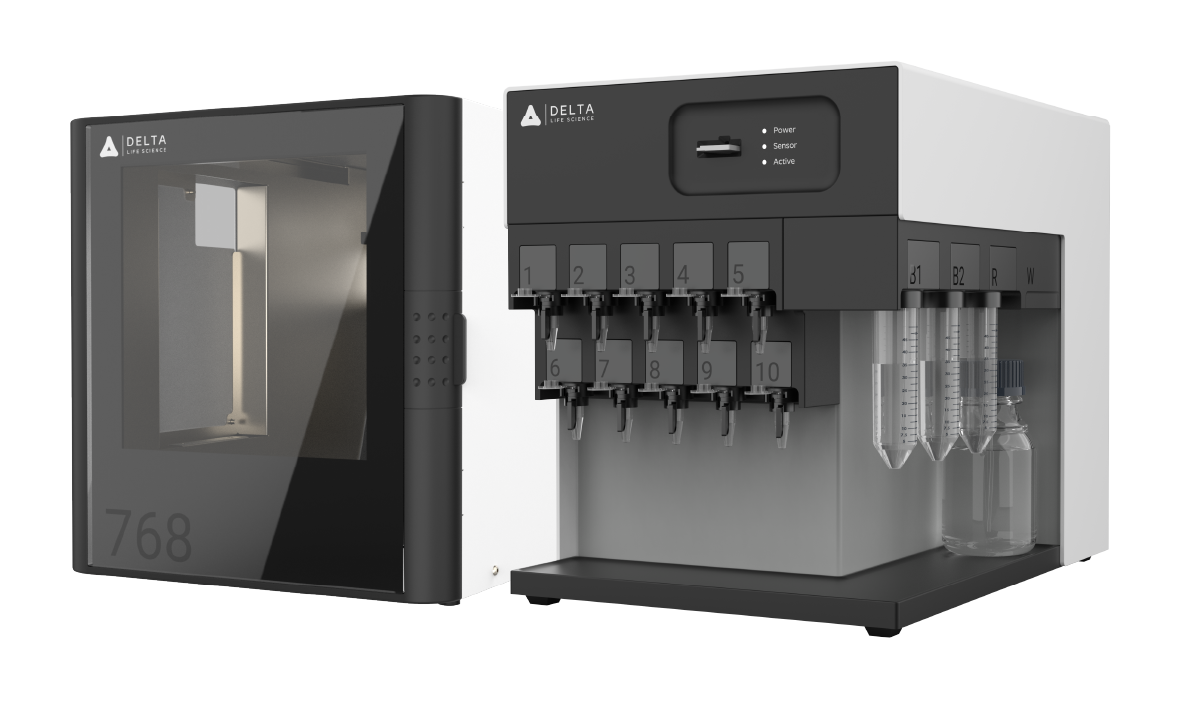
Delta Life Science inQuiQ 768 high-throughput photonic biosensor instrument

What the inQuiQ brings to CROs and CDMOs

One sample can answer more questions. The inQuiQ puts multiplexed analysis into a single run.
01
Throughput
Scale
Platform transition
Sample economy
The way it works today

Margin sits in measurements per run

Sample analysis drives revenue, while method development is overhead. The price per sample does not move; the lever is what each run delivers.

With inQuiQ

One injection, up to 16 sensors

4-channel setup with up to 4 ligands per channel, so panels that previously required multiple assays can run as one method.

16 sensors One method Multiplex panel
The way it works today

A regulated study is several hundred samples of the same method

Clinical and GLP studies need every sample run the same way, with calibration and controls throughout the sequence.

With inQuiQ

Four assays become one

Read PK, immunogenicity, and soluble biomarkers with one assay. Run up to 768 samples, unattended, with reference and control in the same sequence.

2x96 or 2x384 well plates Unattended runs Reproducibility
The way it works today

Moving beyond SPR should not mean starting over

Years of optimising Surface Plasmon Resonance (SPR) assays should not be lost when adopting a new platform.

With inQuiQ

Familiar kinetic workflows, now with 16‑plex

Nanophotonic Evanescent-field Sensing (NES) preserves familiar kinetic workflows while adding 16-plex measurements, high sensitivity, and compact hardware.

NES technology Kinetic workflows 16-plex
The way it works today

Every microlitre should deliver more information

Clinical and process samples are valuable, limited, and rarely arrive in ideal conditions.

With inQuiQ

Clean signals and multiplexed data from every injection

The antifouling hydrogel maintains clean signals in complex matrices, while multiplexed measurements extract more data from every injection.

Antifouling hydrogel Complex matrices Multiplexed data

Throughput, multiplexing, and assay freedom

DetectionNanophotonic evanescent field sensing
Sample capacityUp to 768, from 2×96 or 2×384 plates
Sample loops100 µL and 250 µL
Channels4 flow channels, 4 sensors each
Flow cell temperature16 to 40 °C
Affinity range10 pM to 10 mM

Throughput in series, unattended

Run up to 768 samples sequentially without an operator. Saved assay sequences keep the method consistent from first to last sample.
768 samples 2×96 / 2×384 Unattended 100 / 250 µL loops

One injection, a full panel

Read multiple targets from the same injection, enabling PK, immunogenicity, and soluble marker measurements in one assay.
4 channels 16 sensors Flexible assay design

Kinetics as well as concentration

Get quantitative concentration data alongside binding kinetics, including kon, koff, KD, and active concentration.
KD kon koff Active concentration

Data that holds up in a regulated workflow

Save and reuse methods, control temperature, and export full sensorgrams for consistent analysis across batches, sites, and stages.
Saved methods 16 to 40 °C Batch to batch
Start with a conversation

Run your assay on inQuiQ 768

Bring an assay you run today. We’ll map it onto the inQuiQ and show the throughput, kinetics, and reproducibility side by side.

Questions service labs ask

inQuiQ 768 runs up to 768 samples, injected one after another, from 2×96 or 2×384 well plates. Runs are unattended, and saved assay sequences hold the method constant across the series so calibration, controls, and study samples are treated identically.

With in-flow immobilisation, the capture molecules are introduced through the fluidic channels and immobilised directly onto the sensor surfaces. The inQuiQ has 4 independent flow channels, allowing different surfaces to be prepared in parallel while keeping the setup simple and reproducible.

To analyse a full 16-plex panel, you can also use a spotter to prepare the chip. A spotter precisely deposits different capture molecules onto defined sensor locations, allowing each of the 16 sensors to carry a different target. This is done as a separate chip-preparation step before the measurement.

In many cases, yes. Targets for PK, immunogenicity, and soluble biomarkers can be placed on the same chip and read from one injection, which replaces several single-analyte assays with one method. Assay design is confirmed with an application scientist before transfer.

Yes. The antifouling hydrogel surface limits non-specific binding in serum, plasma, CSF, and culture supernatant, and unpurified samples run directly once filtered through a 0.22 µm filter. Reference channel subtraction removes bulk refractive index and matrix effects.

Precise, accessible, flexible label-free biosensing, powered by integrated photonics.

Stay Updated on the inQuiQ 768 Launch